The conflict with Iran is framed as a conflict over nuclear proliferation. So important is it, we are told, that Iran does not get nuclear weapons, that we could risk war and death and suffering and trillions of dollars to prevent it.
But the story gets bizarre after we find out that U.S. intelligence has repeatedly concluded with high confidence that Iran is not developing nuclear weapons and has demonstrated no intention to do so. Even the supposedly controversial IAEA report found that there was no evidence Iran had enriched uranium beyond the 20 percent threshold and in fact no evidence that Iran had diverted any nuclear material for a clandestine weapons program.
So why the aggressive posture towards Iran? Why have we heaped the harshest set of economic sanctions in the world on Iran – which Columbia University Professor Gary Sick has called “an act of war”? Why do we have Iran militarily encircled with military bases and client states? Why have we supported Israeli proxy terrorism on Iranian soil? Why is it that not a week goes by without an explicit threat of preventive attack on Iran? It can’t be for the nuclear weapons program: it doesn’t exist.
In the years following the 1979 Iranian Revolution, which brought the current rulers to power, the framing of the conflict with Iran was quite different. It’s true, U.S. and Israeli officials have been falsely claiming an Iranian nuclear bomb is right around the corner since the early 1980s. But the conflict was framed more with the Islamist movement and the possibility that it might spread across the region, changing the governments throughout the Middle East.
In a secret memo written in 1982 to the National Security Council, this framing was recognized. But it was taken an important step further.
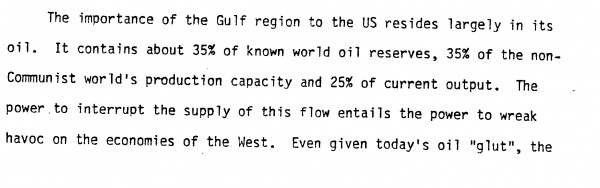
The memo goes on to explain that any interruption in the flow of oil “if prolonged for months, would result in a fall in world-wide economic output comparable to the Great Depression of the 1930s in the U.S.” It says “whoever is in control of the Gulf’s” oil, “is in a position to have a very large political as well as economic influence in the world.” Iran’s war with Iraq at the time raised concerns in Washington that a possible Iranian victory could lead it to “exert influence” over Iraq and Kuwait and even Saudi Arabia. “We may soon be faced with a situation,” the memo continues, “in which a significant portion of the oil supplies to the West are heavily influenced by Iran or by political forces hostile to the West or by forces unable or uninterested in maintaining the flow of oil.”
Power and influence in the Middle East, and thus the world, was of primary interest in 1982. The same was true in 1954, as a Top Secret National Security Council briefing explained, “the Near East is of great strategic, political, and economic importance,” as it “contains the greatest petroleum resources in the world” as well as “essential locations for strategic military bases in any world conflict.” And the same is true now.
The aggressive postures, military encirclement, and constant threats of attack make much more sense when framed in the terms actually employed by those who craft our foreign policy, instead of the politicians’ pretext of nuclear weapons proliferation, which is fabricated in the case of Iran, as best we know. Iran is a would-be powerhouse in the region, that must be subdued. Hegemony is ours, not Iran’s or anybody else’s. “Blood for Oil” has become a trite framework for thinking about U.S. policy towards the Middle East; it is dismissed out of hand as not useful for the analysis. Less useful, even, than an imaginary nuclear weapons program.