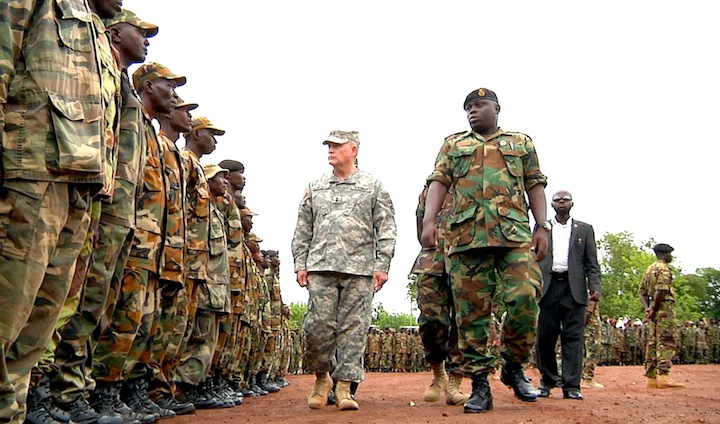
Army Major General David R. Hogg, commander of US Army Africa, inspects Sierra Leone troops, May 20, 2012.
Ben Schreiner points out at CounterPunch that the US involvement in the French-led war in Mali is more about the geo-politics of imperial grand strategy and competing with China in Africa than it is about eliminating serious terrorist threats:
According to the U.S. Africa Command (AFRICOM), the Pentagon plans on deploying soldiers to 35 different African countries in 2013. As NPRreports, upwards of 4,000 U.S. soldiers will “take part in military exercises and train African troops on everything from logistics and marksmanship to medical care.” (The Malian army officer responsible for the country’s March coup just so happened to have received U.S. military training.)
…as the Army Times notes, “the region in many ways remains the Army’s last frontier.” And in order to satiate the U.S. appetite for global “power projection,” no frontiers are to be left unconquered.
…“The U.S. currently receives about 18 percent of its energy supplies from Africa, a figure that is slated to rise to 25 percent by 2015,” Hallinan writes. “Africa also provides about one-third of China’s energy needs, plus copper, platinum, timber and iron ore.”
What’s more, as Maximilian Forte contends in Slouching Towards Sirte, “Chinese interest are seen as competing with the West for access to resources and political influences. AFRICOM and a range of other U.S. government initiatives are meant to count this phenomenon.”
The Obama administration has waged several military interventions in Africa – from regime change in Libya, to a drone/proxy war in Somalia, boots on the ground in and around Uganda, covert special operations in Nigeria, and now Mali.
Through the Pentagon’s Africa Command, the US is now training and equipping militaries in countries including Algeria, Burkina Faso, Chad, Mali, Mauritania, Morocco, Niger, Nigeria, Senegal, Sierra Leone and Tunisia in the name of preventing “terrorists from establishing sanctuaries.” The strategy appears irreconcilable with recent history, however, given how the US-sponsored invasion of Somalia by Ethiopia in 2006 gave rise to the militant group al-Shabaab – now ironically justifying current interventions; and the action in Libya, the consequences of which led to this latest intervention in Mali.
“China-Africa trade grew 1000% from $10 billion in 2000 to $107 billion in 2008,” a trend Washington apparently intends to counter with persistent efforts to produce client military states throughout Africa and extend economic influence over the continent. In the context of Obama’s Asia-Pivot – which amounts to a desperate economic and military offensive aimed at containing China’s rise – this shift in focus to Africa makes a lot more sense.