



Grand Ayatollah Ali Sistani continues to be concerned as to whether elections will be held in January in Iraq, and whether the outcome will reflect the Shi’ite majority in Iraq. He is worried that the system adopted, of nationwide party lists, favors a small set of parties, mainly expatriate. Since the six major parties listed include the two (Sunni) Kurdish parties and the largely Sunni Iraqi National Accord (primarily ex-Ba’athists) led by Iyad Allawi, as well as the mixed Iraqi National Congress, I think Sistani is afraid that the al-Da`wa and the Supreme Council for Islamic Revolution in Iraq – the two main Shi’ite parties – could end up with a minority in parliament.
Both Bush and Allawi affirmed on Thursday that elections would be held as promised. Donald Rumsfeld, whose uncontrollable mouth is sometimes useful insofar as he lets the truth slip, said that elections might not be possible in all the provinces. Allawi minimized the violence, saying that it was confined to three of Iraq’s 18 provinces. This assertion is simply untrue, and is anyway misleading because Baghdad is one of the three Allawi had in mind! Could an election that excluded the capital, with at least five million inhabitants, be considered valid? Denis D. Gray of AP notes:
“However, at least six provinces – Baghdad, Anbar, Diyala, Salahuddin, Kirkuk and Nineveh – have been the scene of significant attacks on U.S. troops and Iraqi authorities in the past month. The only areas not plagued by bloodshed are the three northern provinces controlled by Kurds. The situation in many areas, however, is unknown since journalists’ travel is restricted by security fears.”
(Why is it that only print journalists, and increasingly not television ones, challenge such disinformation from politicians any more?)
The situation is even worse than Gray allows. As recently as August, the British expended 100,000 rounds of ammunition in Maysan province at Amara, saying they had the most intense fighting since the Korean War! Likewise there was heavy fighting in Wasit (Kut) and Najaf. In the map below I made the present security-challenged provinces red, and those that saw recent heavy fighting are purple. I ask you if this looks like the problems are in “three of 18 provinces,” or whether it looks to you like elections held only in the white areas (as Donald Rumsfeld seems to envision) would produce a legitimate government:
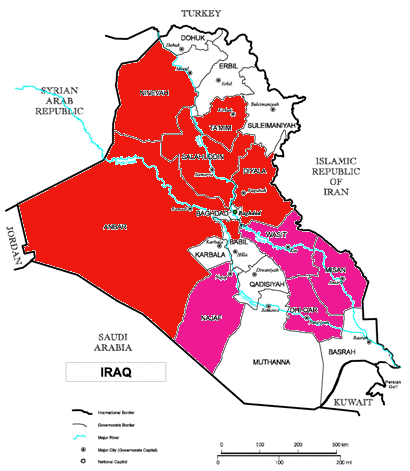
The Allawi/Rumsfeld logic, moreover, presumes that the guerrilla resistance is only able to disrupt the elections in the Sunni Arab provinces. But they have repeatedly demonstrated an ability to strike all over the country. If a long line of prospective voters were standing in Nasiriyah in the south, do you seriously think the guerrillas couldn’t manage to direct some rocket-propelled grenade fire at them? Set off a car bomb?
The real reason for the current plan to raze Fallujah in November or December is the hope that doing so will dramatically reduce the operational capability of the guerrillas, forestalling the Nasiriyah scenario I just mentioned. I don’t think that the guerrillas are so geographically limited or concentrated, however, and very much doubt that this Carthaginian strategy in al-Anbar will work.
Moreover, not having elections in al-Anbar and West Baghdad would be a disaster. The red areas are where the Sunni Arab former ruling minority is situated. They are the backbone of the guerrilla war. If they feel unrepresented by the new government, what incentive do they have to cease their warfare?
On the other hand, if the elections are not held or if their results are widely considered illegitimate, there is a danger that that result will radicalize Sistani and cause him to bring the masses into the street.
Odysseus had to steer between the two monsters of Scylla and Charybdis. So, too, does the U.S. in Iraq.
