



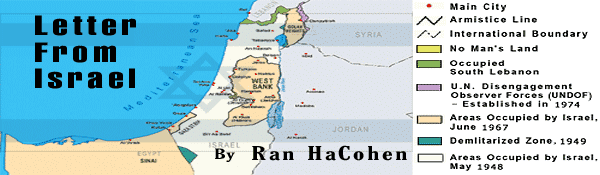
When I was a child, a popular argument in favor of the Israeli “liberation,” i.e., occupation, of the Palestinian territories was its being a blessing for the Palestinians themselves. “When we took it over,” I was told at school, “there were just a couple of cars in the entire West Bank. And look how many they have now!” Indeed, in the first decades of the Israeli occupation, the Palestinian standard of living was on the rise – not because of Israeli investments (Israel never invested a cent in Palestinian welfare or infrastructure), but mainly because Israel exploited the Palestinians as a cheap labor force, and even a cheap labor force gets paid.
The welfare argument cannot be heard anymore, now that one in two Gaza and West Bank households is “food insecure” or in danger of becoming so, as a UN report recently revealed. Not that it changed anything for the Israeli expansionists: once that colonialist argument became obsolete, the supporters of the occupation switched to other excuses. That’s the nice thing about the politics of the occupation: the support for it is based on excuses, not reasons. Whenever one excuse fails, Israel’s propaganda machine offers another.
It’s interesting to observe, however, how Israelis nowadays cope with what used to be such a popular excuse. Having claimed the occupation ameliorated Palestinian life, Israelis now have to face hunger and starvation at their doorstep. How do they live with it?
Starvation Cannot Be Overlooked
Israelis, of course, are human beings. As such, they are seldom indifferent to human suffering. The other week, for example, James Morris, retiring from the United Nations World Food Program, was quoted saying 18,000 children worldwide were starving to death every day. These words, on Israel’s popular Hebrew Web site Ynet (Feb. 17), attracted 100 compassionate readers’ replies. Many of them simply showed their deep sympathy: “It breaks one’s heart,” “Terrible,” “Inconceivable figure, incredible,” “How can one put to bed a hungry child?” to quote just a few. Several readers even asked where one could donate. Others recalled the extreme inequality behind the figures: “Looks like a billion hungry people don’t bother the 5 billion who are not,” or, “At the same time, the world’s richest swim in their money.” Some readers tried to imagine faces behind the figures: “The world doesn’t care about black people.” Several comments mentioned the role of the media: “This topic doesn’t get 10% of the media coverage given to some forgotten wars.” Still others tried a deeper analysis, with comments like “Cruel, materialistic world will soon pay the price,” or, “Result of capitalism which leads to social and environmental crises,” or even, “All this while the Americans pour $100 billion a year on wars.” This was the overwhelming tone of the Israeli reactions to world hunger: human sensitivity, compassion, and empathy, even with some critical political analysis.
Palestinian Plight
A word about the Palestinian plight. The Palestinian territories haven’t suffered an earthquake, tsunami, famine, or any other natural disaster in the recent decades. Their constantly deteriorating economic situation is 100-percent man-made. As the UN and many other reports state, the main causes for the poverty are political: namely, Israeli-imposed closures, and the international and Israeli boycott of the PA. The PA is the biggest employer in the Palestinian territories. Boycotting it to the extent of its being unable to pay wages, in a society crushed by years of Israeli military and economic oppression, inevitably leads to massive poverty. In other words, Israel and the international community are punishing the Palestinian population with hunger for democratically electing the “wrong” party, Hamas. A punishment of biblical dimensions, as suits the Holy Land, with PM Olmert and Condoleezza Rice playing Jehovah.
Overlooking Palestinian Starvation
The UN report on Palestinian “food insecurity” was posted on Ynet too, in a fair synopsis headlined “Half the Palestinians Face Difficulty Getting Food” (Feb. 22), attracting about 75 readers’ comments. With just a couple of exceptions (met with scorn and aggression), empathy and compassion are completely missing from the reactions. “Who cares?” one reader writes. “If my grandmother were alive, it might have interested her,” says another.
Palestinian suffering is not perceived as a human catastrophe, but as a political argument. It’s as if the Israeli propaganda machine managed to turn off the most basic human solidarity within the Israelis, replacing it by cynical sophistry devoid of any humanity. Hungry Palestinians are merely an attack on Israel’s righteousness, and they are confronted as such.
An overwhelming majority of the readers’ letters use one or more of the following ideological strategies:
(1) Outright denial of the suffering: “They look rather chubby on TV.” And why not? Denying the facts is always the zealot’s refuge.
(2) Palestinians do suffer, but it’s good. “Pity, but that’s the only way to put them on the right track”; “There will be peace when the other half is hungry too.” Here one can clearly see seeds of support for a genocide. Similarly: “[To the] government of Israel: encourage them to get up and go!!!”
(3) Palestinians may be suffering, but it’s none of our business. “We pulled out, haven’t we? So what have I got to do with it?” one reader asked. The UN report, needless to say, concerns not only Gaza but the West Bank, too; there was no Israeli pullout from the West Bank, but many Israelis would actually like to believe that by caging West Bank Palestinians behind walls, Israel has nothing to do with them either. Interestingly, if this argument were true, one would expect to find a similar compassion to that expressed toward world hunger in general; but this is not the case. For many Israelis, a hungry child in Ghana is a stain on their collective conscience, whereas a hungry child in Gaza – an hour’s ride from Jerusalem or Tel Aviv – is simply none of their business.
(4) Palestinians might be suffering, but we Israelis are the real victims. This is a perpetual Israeli propaganda line: the media is “unbalanced” (anti-Semitic, etc.), so our suffering is left out. Exposing its futility, one reader carried out the routine procedure mechanically, comparing the two peoples on an economic level: “One could have made the same survey in Israel and got the same results.” Sure thing: Israel’s GDP per capita is $26,000, compared with $1,000 in the occupied Palestinian territories.
(5) But this last argument is often combined with the most popular propaganda guideline of all, namely: Always use the magic word “Terror” to turn the Israelis into victims and the Palestinians into “terrorists.” “Terrorists” are unworthy of human compassion, not even when they are starving; moreover, their suffering is always their own fault. Dozens of letters fall under this strategy: “Let them stop wasting their money on ammunition”; “Let them go to work instead of throwing stones”; “You support terrorism so enthusiastically – I wish you success with other aspects of life”; “The fact that they’ve got no food doesn’t mean they’ve got no money to buy it!!!”; “But getting weapons isn’t difficult at all”; and so on.
Palestinian “terror” is conceived of as an eternal, inherent, never changing, and unmotivated national trait (“No wonder, after 120 years of terrorism,” one reader explains), in which all Palestinians equally partake – doctors and nurses, merchants and students, the elderly and children – and for which they all deserve the punishment of starvation, inflicted upon them by an invisible, unnamed, but ultimately just hand.
(6) One last, related motif is to accuse the Palestinian leadership. “Demand explanations from your leaders, who get fatter every day”; “With their kind of leadership, they should be grateful that they’re still alive. It’s really a shame that the Palestinian blindly follow their stupid leaders.” Obviously, corrupted leadership is the cause of much of the world’s poverty. In fact, Fatah’s inherent corruption was precisely what made so many Palestinians vote for Hamas. There can hardly be a better illustration for the American export product tagged “Democracy”: the occupied Palestinians have a free choice between starving under the corrupt American-backed Fatah regime and starving under the internationally boycotted Hamas government. It’s a free (occupied) country, you know.
The Israeli reactions to the Palestinian suffering for which they are morally responsible, especially when set against the background of their ostensible concern about world hunger, show how pervasively inhumane the Israelis have become. A well-oiled propaganda machine turns them from compassionate human beings into heartless parrots of state demagoguery, ready to ignore, excuse, and even support the starvation of the other nation with which they share the same land. The dehumanization of the Palestinians by Israel has dehumanized the Israelis themselves.
