



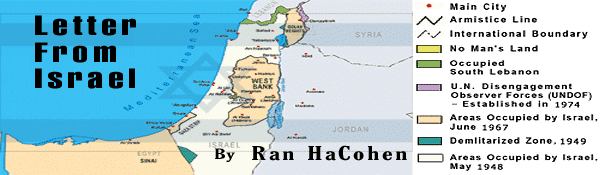
“Out of the north an evil shall break forth upon all the inhabitants of the land” (Jer 1:14) is a verse every Israeli pupil learns by heart. This biblical truth has never been more true than these days: the Syrian President, in a major threat to the Jewish state, offers Israel to resume peace talks. A blatant crime against war itself. Israel, understandably, is forced to defend itself.
There are several convincing reasons why Israel should reject the peaceful Syrian hand. First of all, Syria should come to the negotiation table without any preconditions. When Assad proved evil enough to accept this, Israel demanded that Syria stop it alleged support for “terrorism” (and accept the Israeli-American definition of terrorism, to include resistance to occupation). Fair enough: both sides, except the Israeli side, should come to the negotiation table without any preconditions. Imagine Syria demanding that Israel end its occupation, or just dismantle its death squads, as a precondition to resume peace talks.
Then we are told that president Assad is young and inexperienced. A problem indeed. A good solution would be to reject his offer for a few more decades of hostility, when all our “experts for Arab issues” will be able to claim safely that he is too old to change, and/or that his days are counted. Then we can wait for his successor, hopefully a young and inexperienced one.
A clear evidence for Assad “inexperience” are his manners. The Syrian president chose to convey his peaceful message to Israel in public. “There are covert diplomatic channels for such a message,” official Israel says triumphantly. Indeed, how irresponsible of Assad. If he had conveyed his message confidentially, Israel could (1) again dismiss it as unserious, because only an open message preparing the Syrian public for the policy change would have proved Assad’s real commitment; and/or (2) Leak the secret talks in order to stop them, just like it did recently with Libya. In fact, as even senior mainstream analyst Ze’ev Schiff observes, Israeli leaks are far from haphazard: “In most cases a leak relates to the start of contacts with some Arabs, and after the leak, the contacts are usually broken. There is scarcely any doubt that the leak is aimed at thwarting the contacts and even smearing those Israelis trying to nurture connections with the Arab side.[…] In many cases, this has succeeded. The Arab side is put off.” (Ha’aretz, 16.1.04)
A further argument is that Assad is just yielding to the American pressure, and wants to promote Syria’s interests by improving his relations with the US. A head-of-state actively pursuing his country’s interests is indeed an outrageous idea. And as for yielding to pressure, it reminds me of the Israeli army initiation rite, when a group of old soldiers gives a newcomer a live hand-grenade, all yelling at him: “throw it away, or it explodes in your hand!” Once the young soldier hurls the bomb, he is mocked at: “You chicken, yielding to social pressure…”
A major, persistent claim is that Israel cannot run peace talks on two fronts at the same time. Very understandable: Israel’s military strategy has always been based on the assumption that it should be able to cope with war on all fronts at once: to face a simultaneous attack on both the Egyptian and the so-called Eastern front (i.e. Iraq, Iran, Syria, Jordan and Saudi Arabia all joining forces together; an imminent scenario!). But holding peace talks on two fronts at once? That’s truly impossible. Just think of two negotiation teams, with their regular flights, fax and phone bills. A small state like Israel can simply not afford it. Even a self-hating Jew like myself understands that it is impossible to launch peace talks on a second front. But I wonder: what is actually the first front? Surely not peace talks with the Palestinians, that exploded more than three years ago and have never been resumed?
And then the ultimate excuse: the US is not interested in Israeli peace talks with Syria. Indeed, unlike Assad who is trying to promote his country’s interests, Israel’s government came to power to pursue American, not Israeli policy goals. But granting that, the US has been quite reluctant towards several aspects of Israel’s policy: the illegal settlements are repeatedly condemned as “obstacle to peace”, and the Apartheid Wall has not been all too welcome in Washington either. Why is Israel ready to defy its sponsor to save the occupation, but happily embraces the American position when peace talks are threatening? Obviously, if the American administration had urged Israel to move towards peace, Israel could claim it “would not yield to pressure”. Rejectionism is clearly a win-win policy (and to hell with the victims of war).
The Press
Since Likud is in power, not all Israeli columnists are blind to all that. Several of them write more or less openly that Syria has no partner for peace because of Sharon’s rejectionism. But many of them would immediately support Sharon if he goes for Labour’s favourite option, i.e. endless negotiations that lead nowhere and just serve to win time; they therefore avoid mentioning the obvious price of peace with Syria. After all, “peace talks” is a good sound bite for foreign investments. As I have written before, Israel occupied the Golan in 1967 not because of Syrian aggression but for common greed for the Heights’ fertile land, and since no state succeeded in moving an international border by force in the post-WW2 era, there is no reason for Syria to give up its claim to get back all its territory. One can almost admire Sharon’s honesty when he reminds that peace with Syria means giving the entire Golan back. Right-wing columnists like Yisrael Harel (Ha’aretz, 15.1) – too naïve for the option of negotiations not as a way to peace, but as a bypass road around it – suggests that Israel exploit Syria’s despair to make it “compromise with reality” and give up its claims; a Syrian territorial concession to Turkey has thus been overemphasised in the Israeli press.
The Military
But who cares about press or politicians, or even about Israel’s president’s invitation to Assad to “visit Jerusalem” – too little, too late, and too transparent to convince anybody. After all, it’s the Army that runs the country, and it has its less subtle ways to convey messages. Though offices of some Palestinian resistance groups have been based in Damascus for decades, only in the past months did Israel start threatening Syria after every successful Palestinian attack. The first non-diplomatic hint was launched last August (Ha’aretz, 17.8.03), when Israeli air force planes breached Syrian sovereignty and flew over Assad’s summer palace in northern Syria.
Israel’s military response to the present Syrian peace threat has been clear enough: Brig.-Gen. Eval Giladi, head of planning in the IDF’s Planning Branch, said that Israel could occupy Damascus as quickly as the Americans had taken Baghdad (Ha’aretz, 31.12.03), and that Israel should think of a war with Syria in terms of “regime change” (Israeli TV news, the same day). Not a lot of diplomatic nicities on this end.
Along with a $60m plan to build homes for thousands of new settlers on the occupied Golan Heights, indented to increase the population by 50% over three years and unveiled at just the right time, Syria seems to have gotten the message: Assad, we are now told, “does not believe a peace agreement with the present Israeli government can be reached” (Ha’aretz, 18.1). I wonder why.
– Ran HaCohen
