



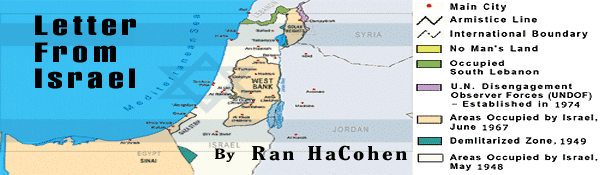
There is nothing very complicated or mysterious about the Israeli-Palestinian conflict. Never trust those who present it as an extremely complex issue, with endless political, historical, religious and cultural repercussions, on which you cannot take an informed stand without a Ph.D. in history and three decades of political activity for AIPAC. It’s quite simple: the Arab states and the Palestinians have in fact acknowledged Israel’s right to exist in peace, if it withdraws from the occupied Palestinian territories taken in 1967; whereas Israel wants to keep these territories, though it doesn’t quite know how. The conflict is as simple as that.
Occupation – Direct vs. Indirect
Within the Israeli ruling clique – the military and political echelon – there are two basic attitudes on how to rule the territories: a direct attitude, and an indirect one. The direct attitude wants the Israeli army to do the job; the indirect one would rather rely on co-opted Palestinian elements. There are, of course, myriad nuisances between these two poles – after all, each politician and every columnist tries to be original – but these are the basic approaches. Note that none of them wants to end the occupation: they both want to ameliorate it.
Each attitude has its pros and cons. The direct attitude trusts the Israeli military, which is reliable and always eager to extend its sphere of power; but this attitude has a minus on the public opinion front, and its financial costs are high. Using Israeli soldiers to rule millions of civilians also leads to friction with the Israeli Supreme Court and with Israeli human rights groups. The indirect attitude solves many of these problems: the policing is delegated to Palestinians unhampered by the Israeli law, it’s cheaper and looks better; but the co-opted Palestinians are not as reliable and might betray Israel’s interests for their own people’s sake.
Oslo and After
The Oslo years – 1993-2000, under Prime Ministers Rabin, Peres and Netanyahu – were thus far the most elaborate experiment in implementing the indirect attitude, using the Palestinian Authority as Israel’s long arm. It was in fact quite successful: under cover of an ongoing “peace process,” the Israeli settlements grew enormously, and the occupation could be entrenched ever more. It was Prime Minister Barak, who had opposed the Oslo agreements all along in favor of the direct attitude, who – probably fearing the Palestinian Authority could become too independent – effectively managed to put an end to this experiment (and blamed the Palestinians for it). To undo the realities shaped by the indirect attitude, Barak and his successor Sharon launched the most comprehensive military assault on the Palestinian territories, directly re-occupied almost the entire Palestinian territories and demolished Palestinian self-policing, destroying its installations, smashing its symbols of sovereignty, and killing Palestinian policemen whenever possible.
Unique Mixture
Occupation is an inherently unstable situation. Therefore, neither the direct nor the indirect attitude could ever be implemented in full. For example, even when Israel, according to the principles of the direct attitude, confines Arafat to his devastated office in Ramallah, it still employs the propaganda of the indirect attitude whenever it accuses the caged “president” of not fighting off terrorism, as if he were still in charge of Israel’s interests. More importantly, during the shift from indirect to direct occupation after Oslo, Israel succeeded – in a unique and unprecedented manner – to not resume its responsibilities for the daily life of the occupied population, leaving education, health services, etc., to the all-but-destroyed Palestinian Authority and to the “donor states”: a convenient relic of the indirect attitude, which even the most devoted supporters of the direct occupation are careful to keep in place, for obvious financial reasons.
Turn of the Tide?
After four years of direct occupation, there are now signs that Israel is trying to reverse the tide and return to a more indirect kind of occupation. Which is why these days are becoming quite reminiscent of the Oslo period.
A shocking similarity to the Oslo years was apparent a few weeks ago, when a controversy broke out in Israel over “rearming Palestinian police,” in the very same terms as during the Oslo years. The right wing aired its old Oslo slogan, “Don’t give them guns,” whereas supporters of the measure explained that unless it is taken (i.e., unless indirect occupation is partly re-installed), Israel will be blamed for “chaos” in the Palestinian territories. By the way, only few realized that the (meanwhile suspended) measure had nothing to do with “re-arming,” but rather with changing the rules of engagement: Palestinian policemen, armed during the Oslo years with full Israeli consent, their weapons all registered in Israel, were turned during the Intifada into legitimate military targets (Newspeak reported this license to kill as “armed men identified and shot by the Israeli army”), a decision which Israel may now reverse.
“Disengagement”
The most apparent shift in public discourse, also quite reminiscent of the Oslo years, is due to Sharon’s “Disengagement Plan,” which consists of three parts:
(a) entrenching the Israeli occupation in the West Bank by strengthening and expanding the “settlements blocks,” aided by the Apartheid Wall;
(b) entrenching the siege of Gaza from the outside, in the typical manner of indirect occupation, culminating in the crazy plan to dig a moat along Gaza’s border to separate it from Egypt; and
(c) dismantling the Israeli settlements in Gaza.
Officially, this plan is presented as “unilateral,” since both sides are still hesitant to be seen as returning to the framework of indirect occupation; but in fact, the media report a growing cooperation between Israeli and Palestinian security agencies. The cooperation seems to be so satisfying that, in a most unusual step, Israel broke its habit and did not point a finger at the Palestinian Authority (but rather at Syria) for the most recent terror attack in Beer Sheva.
Not surprisingly, parts (a) and (b) of the Disengagement Plan are already being implemented, with full American support. As for (c) – evicting the settlements – which reigns exclusively in public discourse – the only decision passed in cabinet so far states that “a vote on the dismantling of settlements would only be held by March 2005,” i.e., that no settlements would be dismantled for the time being.
Deeds, Not Words
The possible return to a more indirect occupation, and the similarities to Oslo, should be taken as a warning. Most alarming is the total surrender of the entire liberal media and intellectuals to the legend of Sharon’s “change of heart,” from a bloodthirsty warrior to a “man of peace.” Just like in the Oslo years, when Israel managed to double the settlements’ population, not the least thanks to columnists and intellectuals who supported the alleged “peace process,” Sharon’s “conversion” is taken for granted in spite of all contrary evidence.
The prime minister who is supposed to evict up to 20 Gaza settlements has so far not kept his vow and not dismantled even a single illegal outpost in the West Bank, with his forces allegedly “helpless” before resistance from “extremist settlers” whenever it comes to it (how easy it is to destroy Palestinian houses en masse!). The massive expansion and over-subsidizing of the settlements goes on as usual: with the so-called “Oslo support,” given to Jewish settlements since the 1990s (when we were all told they would soon be dismantled!), a settlement like Kiryat Arba gets 12 times more government subsidy per capita than the socio-economically similar Bet Shemesh inside Israel proper (Ha’aretz 25.8.04). And the daily killing of Palestinians persists, this time with the pretext of “preparations for the Disengagement Plan.”
The peace camp, in Israel and worldwide, must be careful not to fall into the Oslo trap once again. An indirect occupation is as bad as a direct one, and the peace camp should neither trust Sharon’s new image nor support trading direct occupation for an indirect one. Instead of quoting Sharon’s nice but empty words, his actual atrocious deeds should be exposed. Otherwise we might wake up once again, too late, to discover that while we were supporting Sharon’s vague promises, his actions prepared the ground for further decades of bloodshed and hatred.
