



Out of almost 1,400 words, it was the following short sentence that attracted almost all the readers’ reactions to my previous column:
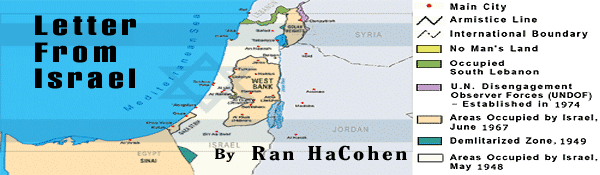
“The Arab states and the Palestinians have in fact acknowledged Israel’s right to exist in peace, if it withdraws from the occupied Palestinian territories taken in 1967; whereas Israel wants to keep these territories, though it doesn’t quite know how.”
It is indeed impressive how successful Israeli propaganda and the Western media are in obscuring the simple fact that ongoing conflict is the result of a voluntary Israeli policy, in which Arabs and Palestinians play a subsidiary role. Sharon’s indelible smile is quite justified: by now he can say the whole truth about his resolute intention to perpetuate war and to sabotage any serious peace initiative, and still preserve his image as “man of peace.” The so-called “man of peace” openly says that he rejected an American proposal last year to resume peace talks between Israel and Syria, and rejects out of hand a full withdrawal from the occupied Golan (as international law and UN resolutions demand). He openly admits his intention not to honor the U.S.-backed Road Map to peace, and prepares the hearts for “decades of stalemate,” i.e., of violence. He even makes clear that he will annihilate Palestinian Authority Chairman Yasser Arafat, freeze the occupation in the West Bank, and put off the road map and the two-state solution for many years. No harm done: Sharon can count on what Ha’aretz‘s well-informed Aluf Benn now terms “the selective hearing” of his audience, who hear just what they want to hear. It is in fact the same “selective hearing” – not individual, but mediated by the entire mainstream media – that turned a deaf ear to the Arab peace initiative or to any peaceful words by any Arab or Palestinian speaker. Contrary to the facts, Israel still preserves “peace” as the first association it raises, and the Palestinians vice versa.
Now let’s see how readers react to this simple truth – i.e., that at present, the perpetuation of the Middle East conflict is the fault of Israel and its greed for land. Italicized quotes without reference are from actual reactions to my previous column.
Just Shut Up!
First, there is the direct-action approach: if you don’t like the message, kill the messenger – or at least send him to hospital. “Ran HaCohen, you are very, very sick. You need a doctor ASAP.” A similar strategy is dogmatic denial: “This is a LIE and this lie makes all the article to be useless.” No explanations given.
Let’s Talk About Something Else
An inevitable accusation (often combined with the sickening allusions to the “almost reflexive anti-Semitism of the left”) is: “where in your note is their any mention of terrorist bombings?” Whenever occupation and settlements – the heart of Israel’s colonialism, therefore the heart of the conflict – are mentioned, one is immediately asked to change the subject and to talk about “security” and “terrorism” instead. It’s not a coincidence or a law of nature: it’s an instruction taken directly from written Israeli propaganda guidelines. Discreetly admitting that “The settlements are our Achilles heel,” the guidelines suggest that “the best response (which is still quite weak) is the need for security.” After all, “Security has become the key fundamental principle for all Americans,” so, therefore, “Security is the context by which you should explain […] why Israel can’t just give up land.”
Sorry, friends: the Israeli Foreign Office has more than enough columnists echoing its propaganda lines; I am not one of them. I’ll talk about terrorism when I like, too; but I’d rather talk about its breeding soil first, which is the Israeli occupation, settlements, and rejectionism.
Mythologies and Lies
Next we get the mythologies. “The author of this article tends to forget that the Palestinians were offered everything this article says they need for peace and rejected it,” one reader writes. “We also do remember that Arafat turned down the deal of the century a few years ago,” says another. “The Palestinians would have pretty much the entire West Bank, the Gaza Strip, compensation for ‘refugees,’ and more […] had Arafat not walked away from the table in 2000,” a third reader echoes. Indeed: the unbeatable Ehud Barak legend, refuted as a mixture of fiction and lies long ago by, among others, Robert Malley, who attended the Camp David talks in person and showed in some detail “why what so many viewed as a generous Israeli offer, the Palestinians viewed as neither generous, nor Israeli, nor, indeed, as an offer.” No need to repeat it all here. But good fiction is stronger than any historical evidence, and people would rather stick to their mythologies than to well-informed firsthand evidence that contradicts their prejudice.
The Spoils of War Doctrines
Next, we have a business hardliner. An “operations manager” writes to me: “When you gain real-estate during a war, it is yours and those who lost the land must suck it up.” People’s life, freedom and basic human rights are neatly reduced to “real estate,” but in a revealing colonialist manner, the pseudo-economic terms cannot conceal the physical violence behind them.
This highly popular (but totally wrong) argument about war as a lucrative real estate business comes in two versions. The variant we have just heard argues that in war, the winning party keeps its spoils: “Might makes right.” The opposite version of the same argument claims that in war, the aggressor is punished by territorial loss: “Crime doesn’t pay.” “One of the accepted modes of punishment for bellicose countries is the loss of territories,” writes some right-wing moron in Ha’aretz. Funny how outright bestiality and pseudo-morality can both yield the very same result.
In fact, both lines of argument are wrong. It took the human race two World Wars and hundreds of millions of casualties to understand it and to ban any territorial change achieved by violence. Since 1945, not a single state on the globe managed to move its border by violence and get away with it. The question of “who started” is irrelevant: every country in war portrays itself as a victim and blames the other side; even unprovoked aggression can be presented as a preventive measure of self-defense, and then go figure.
Therefore, Iraq could not keep Kuwait as war spoils, Indonesia was finally kicked out of East Timor, Russia out of Afghanistan, Israel out of Lebanon and out of the last grain of sand of Egypt’s Sinai. Nevertheless, neither Iraq nor Indonesia nor Russia nor Israel were ever expected to give up a single inch of their own territory as punishment for their aggression. That’s how things work: in the post-WW2 era, borders can be moved exclusively by peaceful means. Even the American empire, in spite of its inherent self-righteousness and deep contempt for international legislation, always stresses its commitment to the territorial integrity of the countries it habitually conquers.
Two to Tango
I cannot deal here with all the arguments I received. About the typical strategy of diving into history to make Palestinians pay for the alleged sins of their ancestors, I said a few words in an earlier column. One last argument I’d like to mention briefly is “oversimplification”: “it is not at all this simple.” This is always true. It takes two to tango. If the Palestinians were willing to give up their land, water, and human rights quietly, go live somewhere else, or, even better, stop living altogether, we could have had peace long ago; so it’s their fault too. But is this really such a moral and impartial point of view? I am not convinced.
It’s one thing to assert that no one party is exclusively responsible for a conflict. For example, the morally repulsive Palestinian terror against Israeli civilians has been highly counterproductive to any peace efforts (and is not rendered any better by the Israeli terror against Palestinians). But the leap from this reasonable assertion to the claim that both parties are equally responsible for a conflict is a leap from common wisdom to a barbarism that always serves the stronger party as such.
