



To appreciate the breathtaking magnanimity expressed by this short slogan, one needs to remember its context. Imagine: a foreign army occupies your village for decades, reduces you to subjects without any rights, arrests you arbitrarily, savagely tortures the arrested, and, on top of it all, sends mighty bulldozers to erect a gigantic wall on your land, locking you up as in a cage. And your reaction? Peaceful demonstrations, shouting “No to the Wall” – but “Yes to Peace," to peace with your very oppressor and dispossessor.
Budrus, where this slogan was coined, is a small village of some 1,200 Palestinians in the northern part of West Bank, just across the Green Line. Few Israelis have ever heard of it; but some may remember neighboring Kibia, just a mile to the east, where, on Oct. 14, 1953, an Israeli army unit – led by a young officer called Ariel Sharon – ravaged the village (then still under Jordanian rule), destroying 40 houses and killing more than 50 people, an atrocity that caused international outrage and was strongly condemned by the UN Security Council.
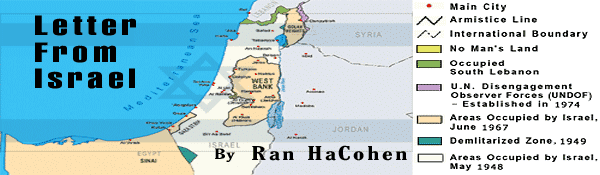
Half a century after that massacre, PM Ariel Sharon sent his bulldozers to the same rural area. Many imagine the Wall as a kind of border separating Israel from the Palestinian territories. The facts are different: the Wall twists like a snake entirely inside the Palestinian territory, and – in combination with other physical barriers, most notoriously roads for-Israelis-only – it creates numerous small enclaves, in which Palestinian villages and towns – sometimes just a few hundred people, less than in any average prison – are locked up, unable to leave their unsafe haven except by mercy of an Israeli soldier at the gate, when equipped with proper permits issued (or rather not issued) by the Israeli army. The contiguous territory in-between the enclaves is designated for the Israeli settlements.
Living in a Cage
A‘ed Murar from Budrus counts three levels on which the Wall is destructive to Palestinian life. First the immediate level: the Wall takes the agricultural lands and water wells of the village, either because it is constructed on them, or because they are left outside the Wall, inaccessible to the farmers. The section of the population that depends on agriculture thus loses most of its means of survival.
The second level is imprisonment: there are no clinics or hospitals, no higher schools or universities, nor any other social and economic infrastructure inside the enclave; moreover, about 80% of Budrus’ population works outside the village: they, too, lose their means of survival as their access to the outside world is dependent on Israeli army caprices.
The third level is that of nation and vision: by locking up the Palestinians and taking the land in-between the enclaves, Israel robs them of their future, of a contiguous territory for the Palestinian State promised in President’s Bush roadmap. The Palestinians are thus left with no way to earn their living, with no infrastructure to run their present life, and with no hope for the future.
A Short History of the Wall
Historian and Ta’ayush activist Gadi Algazi distinguishes several periods in the construction of the Wall. From April 2002-May 2003, the Wall was built with incredible speed – 300-500 bulldozers working simultaneously – hardly attracting any public attention at all, neither in Israel nor abroad, thus enabling the Israeli government to quietly and irreversibly change the geography of the land for decades. The Israeli public had the illusion that the Wall was being built along the Green Line – a good reason for naïve peaceniks to support it – and that at worst it was perhaps conflicting with property rights of some Palestinian landowners along its route. Even the Palestinians could hardly grasp the full impact of the project, both because of its indeed incredible dimensions, and because Israel refused to publish any maps at the time, so that information was scarce in a West Bank hardly recovering from the massive Israeli aggression of “Operation Defensive Shield." Some resistance to the Wall was led by small groups of Israelis, international activists, and Palestinians, like in the Mas’ha camp.
May 2003 signaled a change: since then, the Wall has become the focus of media attention, and turned into a political issue in Israel and abroad. Demonstrations, many of them by Israelis and international activists, and their violent dispersion by the army increased public awareness and reduced the pace of construction. The clear decision of the International Court of Justice against the Wall as well as the critical position taken by the Israeli Supreme Court regarding its route mark a peak in the public struggle against the Wall; consequently, in the summer of 2004, the construction was virtually stopped, and the Israeli establishment started looking for new tactics.
It is in this period, in places like Budrus, that people like Mr. Murar – who had participated in the first Intifada and had been jailed and brutally tortured by Israel – reached the conclusions that resistance to the Wall should be led and organized first of all by Palestinians themselves; that waiting quietly for courts and verdicts was not enough; and, above all, that nonviolent demonstrations were the best weapon of the weaker side. He believes this for moral reasons, but also because nothing could harm the Palestinian interest more than violence, immediately exploited by Israel to distract public attention from the Palestinian plight and to accelerate the construction project behind the thick screen of “fighting off terrorism." A’ed Murar calls it the Third Intifada: the Intifada against the Wall.
Since the Palestinian Authority offered no real strategy or help in the villagers’ struggle, they had only themselves to rely on – aided by Israeli and international supporters, like Ta’ayush, International Solidarity Movement, or Anarchists against the Wall. The Third Intifada is a popular uprising: in villages like Budrus, party affiliation and other differences are put aside, and the whole village marches together time after time to demonstrate against the Israeli bulldozers. Footage taken in several such demonstration shows the utter embarrassment of the Israeli soldiers, armed to the teeth against unarmed men, women, and children, who can stand for hours just a few meters away from them singing and shouting without any violence at all. If at last a single stone is thrown, the soldiers seem to be truly relieved: they immediately employ their heavy truncheons, shoot tear-gas and rubber-covered bullets at the crowd, and make violent arrests. But the resistance is not in vain: when a whole village stands together day after day, even the cruelest army must have second thoughts. So far, the demonstrations in Budrus managed to save the biggest plantation of the village from Israel’s bulldozers.
Crucial Stage
The construction of the Wall, says Algazi, seems to have reached a crucial period. Following the verdicts from The Hague and Jerusalem, the Israeli establishment made a pause and took some time to reorganize and elaborate a new route and new strategies; these are now ready, and the construction of the Wall is about to resume in full speed. Signals and threats conveyed to inhabitants in Budrus make it clear that Israel is not going to give up easily on their land and water. The number of soldiers sent to demonstrations in villages like Budrus has been reduced, to increase the soldiers’ insecurity and ease their finger on the trigger, and villagers are warned that if they do not capitulate this time, live ammunition may be used.
This nonviolent popular struggle is hardly reported in mainstream press. One needs to refer to alternative media to read about it. The idea of nonviolent Palestinian resistance sharply contradicts the stereotype of Palestinians as a “nation of suicide-bombers”; reporting peaceful Palestinian demonstrations is highly undesirable in official Israel’s eyes. For all those reasons, this is a struggle very worthy of both public interest and support: The future of Israel/Palestine will be decided here, on the ground, rather than in press conferences in Washington or coalition intrigues in Jerusalem.
