



Hamas won the Palestinian elections. Huge surprise. Years of Israeli policy to crush secular Palestinian nationalism succeeded beyond expectation. Who could predict that in the Middle East, where causes invariably produce unintended effects (oh, those irrational Arabs!), Israel’s policy to weaken Fatah would end up in a landslide victory for Hamas?
Israel birthed and nurtured Hamas. In the past half-decade, Israel has been doing its utmost to weaken the Palestinian Authority. Be it prisoners’ release, freedom of movement, work permits, even just high-level meetings – if anything could strengthen the Palestinian Authority, Israel wouldn’t allow it. The top was Sharon’s unilateral withdrawal from Gaza: the Palestinian Authority begged for a symbolic role, an appearance of coordination, which would enable it to take some credit for Israel’s pullout and restore the Palestinians’ confidence in negotiations and the “peace process." Sharon indeed coordinated his moves – with the U.S., with Egypt; but not with the Palestinian Authority. The PA was left out of the game, humiliated, and Hamas could capitalize on the withdrawal as its victory.
Corruption: A Lesson to Learn
Moreover, the Palestinian vote for Hamas was predominantly a protest vote. Hamas voters are not necessarily Islamic fanatics (some of them are even Christians), but are all fed-up with the Fatah-led corruption. This notorious corruption is partly of a Palestinian brand, partly inspired by Israel and the Oslo system: quite a few Israelis made a fortune by dubious businesses with corrupt Palestinian monopoly owners, monopolies granted by Arafat to win his clique’s support. The Palestinians used the democratic elections to punish the corrupt party.
This is a big difference between Israel and Palestine. Israelis can only envy the Palestinians for having a major party that is not associated with corruption. In Israel, all the bigger parties are equally corrupt. The only party that put the struggle against corruption on its agenda – Shinuy – has disintegrated – for good reason, because this “lawyers’ party” just wanted to replace the illegal forms of corruption with its legalized version: neo-liberal reform.
It’s All Our Land
But apart from that, Hamas and Israel’s leadership have surprisingly much in common. And not just because they both terrorize each other.
Hamas, as its Charter (art. 11) states, believes that since “the land of Palestine has been an Islamic Waqf throughout the generations and until the Day of Resurrection, no one can renounce it or part of it, or abandon it or part of it.” Hamas claims that the whole of Palestine – including what is now Israel – belongs to Islam.
Similarly, all Israeli leaders – Begin, Rabin, Netanyahu, Barak, Sharon, and Olmert – have always claimed that the entire land of Israel, including the occupied Palestinian territories, belongs to the Jewish people, stressing their deep emotions for every inch of it. Asked about his feelings on the West Bank settlements of Ofrah and Bet-El, Ehud Barak, considered the most dovish Israeli prime minister, said that for him it was all Eretz Israel (the Land of Israel). Israel’s new foreign minister Tzipi Livni just told the New York Times, “I also believe, like my parents, in the right of the Jewish people to the entire land of Israel." Olmert now speaks in similar terms. Even when Israeli leaders talk of giving up parts of the land, they always stress their belief that these parts belong to us, but that they have to be evicted due to pragmatic considerations (demography, security, economy) – never because of Palestinian rights. Both Israel and Hamas do not acknowledge the other side’s right to the land.
Moreover, both Hamas and Israel formulate their claims on the entire land not in any legal, moral, or pragmatic terms, but in religious ones. It’s nationalism with religious roots, anchored in Heaven and Time Immemorial. Hamas invokes the Islamic term of Waqf; the Israeli discourse is just as theological, even if it is covered by a thin layer of secularity. As Israeli historian Amnon Raz-Krakotzkin succinctly puts it, the Israeli position in a nutshell is “God doesn’t exist, but He promised us this land." Zionism never let go of the Bible as its constitutive charter.
Jews as Dhimmis in Palestine
Consequently, what Hamas offers to the Jews is a status of dhimmi (an officially tolerated non-Muslim) – the status given to “the people of the book” (Jews and Christians) in the Muslim tradition. When Hamas leader Haled Meshal says “we don’t want to get rid of the other," that’s what he means; in the words of the Hamas Charter, “Only under the shadow of Islam could the members of all religions coexist in safety and security for their lives, properties, and rights” (art. 6). The concept is that of an overall Muslim space, in which Jews are tolerated and may have individual rights (like owning property), but only under Muslim hegemony. Jews may even enjoy some collective rights – such as religious autonomy – forming small enclaves within the Muslim space, but only under the auspices of Islam and without challenging its superiority.
Palestinians as “Dhimmis” in the Land of Israel
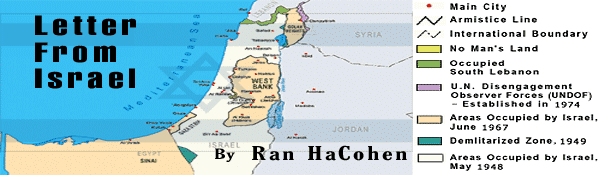
All this is very similar to what Israel offers the Palestinians – with a major difference, that while Hamas dreams of controlling all Palestine, Israel has been controlling the whole Land of Israel for almost 40 years. Since the early 1980s, the main legal procedure used by Israel to take over Palestinian lands has been that of designating them as “state lands.” The logic behind the originally Ottoman law is quite sound: lands that do not belong to any individual belong to the state. Israel as an occupying power has perverted this reasonable law, turning it into a mechanism of racist discrimination: lands that do not belong to any individual Palestinian now belong to the state of Israel, which gives them exclusively to Jewish settlers. Sometimes (like in Amona these days), settlers are removed from private Palestinian lands, but Israel keeps colonizing Palestinian “state lands," rapidly taking over the free lands of the West Bank.
Clearly, the concept here, too, is that of an overall Israeli space, in which Palestinians are tolerated and may have individual rights (like owning property), but only under Israeli hegemony. Palestinians may even enjoy some collective rights – such as municipal autonomy (the Palestinian Authority is no more than that, in fact less) – forming small Arab enclaves within the Israeli space, but only under the auspices of Israel and without challenging its superiority.
Hamas’ Truce, Israel’s Diktat
One may find some comfort in this newly formed symmetry. Israel and the Palestinians are now ruled by rival twins, by religious nationalisms, rigid as theology always is. Both sides are surely aware of the limits of their power and may look for pragmatic concessions that would allow a modus vivendi – without forsaking their long-term vision of subjugating the other. In recent years, Hamas has repeatedly hinted at the pragmatic ladder that would help it climb down the dogmatic tree: a long-term truce, to be kept only as long as it serves Islam’s interests. This is quite similar to the Israeli concept of “interim agreements”; moreover, it is precisely what Israel has been doing all along, breaching each and every agreement as soon as it didn’t serve its interests. It may sound disheartening, but on the other hand, it means that from now on, for a change, agreements should satisfy both sides.
But if the partners’ similarity may facilitate negotiations, the overwhelming imbalance of power undermines it. As part of denying the other’s rights, Israel has been cultivating the “no partner” dogma – the 21st century version of Golda Meir‘s “there’s no such thing as Palestinians." There’s always an excuse not to negotiate: with Arafat because he was too strong, with Abu Mazen because he is too weak, with Hamas because it’s too extreme, etc. As Sharon’s senior adviser Dov Weisglass said, first let the Palestinians become Finns. All the major Israeli parties now talk of taking “unilateral steps," without negotiations, to “shape Israel’s borders” (on Palestinian soil, of course); since Hamas’ victory, even the nicety of “if there is no Palestinian partner” has been dropped.
Is there no Palestinian partner? Of course there is, but not for the deal Israel wants to strike. Israel therefore plans to unilaterally impose its colonialist vision on the Palestinians – to perpetuate the Israeli hegemony in the entire land, with scattered Palestinian enclaves strangled by walls and settlements. Unless the international community grants legitimacy to any democratically elected Palestinian government, Hamas – portrayed as evil incarnate but in fact amazingly similar to its Israeli counterparts – will just be yet another excuse for the diktats that Israel would impose on the Palestinians anyway.
