



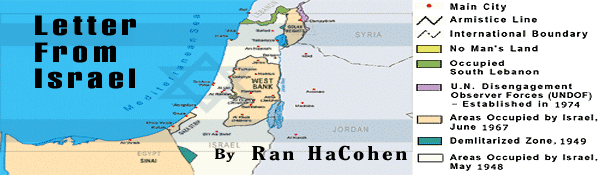
The UN Security Council resolution draft on Lebanon reflects a new stage of Western colonialism in the Middle East, and perhaps a historic precedent: for the first time, the UN Security Council – should the resolution draft be endorsed – breaches the fundamental principle of the right of people under occupation to resist, and in fact legitimizes the violent partition of the sovereign state of Lebanon.
The American-French draft reflects the interests of three central colonial powers in the region: the U.S., the main colonial power in Iraq and Afghanistan; its client and proxy Israel, which is occupying the Palestinian territories of the West Bank and Gaza as well as part of Syria, and occupied south Lebanon for 22 years (1978-2000); and France, the former colonial empire in Lebanon after WWI. No wonder that the draft, which pays lip-service to Lebanon’s sovereignty and territorial integrity, in fact suggests a partition of this small land.
Challenged Sovereignty
Lebanon’s sovereignty has always been challenged. France and Great Britain did not end their colonialism until after WWII. Syria considered Lebanon one of its provinces. Israel’s first leader, David Ben-Gurion, believed the natural border of the Jewish state should be Lebanon’s Litani River, and this legacy has apparently guided the Israeli army ever since.
Up to the last half decade, Lebanon was in fact partitioned into two power spheres: the Israeli-occupied south, and the Syrian-occupied rest of the country. Both countries used each other’s occupation of Lebanon as an excuse not to end their own. Finally, Israel withdrew from Lebanon in 2000, but it has not respected Lebanon’s sovereignty for a single day since. As every UN report for the years 2000-2006 stresses, Israeli jets have violated Lebanese air space by daily overflights, sowing anxiety by sonic booms over populated areas. At the same time, pressure grew on Syria to end its occupation. At last, the international – mainly Western – community made president Assad Jr. withdraw the Syrian forces from Lebanon in 2005.
These developments, which looked like the rehabilitation of Lebanon’s sovereignty, now seem to lead to the very opposite: a renewed Israeli occupation of south Lebanon, supported by the U.S. and France and backed by a UN Security Council resolution.
Israel’s Return
With strong American backing, Israel is at present in a four-week effort to reoccupy south Lebanon.
The decisive player in Israeli politics – the military – is aware of the painful memories many Israeli families still have from 22 years in the so-called "Lebanese mud." Therefore, the reoccupation has been carried out in what the Israeli army jargon calls "a rolling operation." At first, the public and the cabinet were assured that only the air force would be used. A few days into the war, with dozens of Hezbollah missiles reaching as far as Haifa, military sources started to indicate that "Israel cannot win by using air force alone." Ground forces were sent into Lebanon, first in what was described as limited commando operations, then to take over small enclaves close to the border and "cleanse the Hezbollah front line." Four weeks into the war, Israel is seeking to reoccupy the "security zone" it abandoned six years ago, with indications that the Israeli-held area might stretch north to the Litani River and perhaps even further.
Leaflets and heavy fire directed indiscriminately at civilians have driven out most of the population of south Lebanon; many have no houses to return to. The purpose of this ethnic cleansing – similar to that carried out in Palestine in 1948 and in the occupied Palestinian territories in 1967 – is to facilitate the Israeli occupation in the future.
Israel’s Occupation Legitimized
The U.S. has so far blocked any attempt to make Israel cease its fire. Now that Israel is about to reach its desired territorial aims, the U.S. deems it the right time to anchor Israel’s occupation in a UN Security Council resolution.
According to the current resolution draft, the UN Security Council "calls for a full cessation of hostilities based upon, in particular, the immediate cessation by Hezbollah of all attacks and the immediate cessation by Israel of all offensive military operations." Note the asymmetry, as well as the term "immediate." While Israel is occupying Lebanon, Hezbollah – or, as it is often called in Lebanon, "the resistance" (al-muqawama) – is not allowed to take any military action against this occupation. If it does, the resolution draft allows Israel to defend its occupation militarily, as long as it uses "non-offensive" means. Thus the UNSC, perhaps for the first time, waives the moral and internationally accepted legal principle of the right of occupied peoples to resist occupation. The resolution draft not only forbids Hezbollah resistance to the occupation, but also legitimizes Israel’s right to defend its occupying forces against any Lebanese resistance.
No "International Force"
This immediate, interim phase should end when a new UN-mandated international force is formed and deployed to Lebanon. This seems to be the American concession to France. In order to win the past colonizer’s consent, the U.S. offered France a military foothold in the form of an international force that would consist mainly of French troops. The French, however, have been fooled: having betrayed Lebanon for the sweet smell of a colonial foothold, they will get none. The resolution draft sets no timetable for the creation of this new force, which at any rate needs to be authorized in a further UNSC resolution before it is constituted.
Furthermore, this second, future UNSC resolution is made dependent on a "confirmation to the Security Council that the Government of Lebanon and the Government of Israel have agreed in principle to the principles and elements for a long-term solution as set forth in paragraph 6 above, and subject to their approval." As any experienced observer of Middle Eastern diplomacy knows, this condition can be endlessly abused to gain time, just as we witnessed in the Oslo process with the Palestinians, and Israel has a clear interest in procrastination. As long as the two governments have not agreed – and this may take years – Israel can stay in Lebanon as an occupying force protected by a UNSC resolution.
Not surprisingly, then, a senior Israeli official has already said that "there would be no international force, because no agreement about it would be reached." (Ha’aretz, Aug. 7, 2006, Hebrew only; omitted in the English version, and not without reason.)
Vae Victis
Lebanon cannot but object to the proposed resolution, which in fact legalizes its partition. Indeed Lebanon does object. This objection must have been anticipated by the colonial powers. Therefore the mechanism set to implement Lebanon’s partition is deliberately bypassing its government. Since a new international force cannot be deployed in Lebanon without its consent, the resolution draft uses UNIFIL instead: UNIFIL is already on the ground in Lebanon, so it doesn’t need any further Lebanese consent. For this reason, Israel’s request to get rid of UNIFIL had to be rejected; this was portrayed in the Israeli press as a great concession (Ha’aretz‘s top headline, Aug. 6, 2006: "Israel Backs Down: UNIFIL Stays").
The Israeli plans to make Lebanon understand its role in the new regional order – that is, to submit to Israel’s superiority and give up its South – were hinted at briefly at the outset of the war in the words of Israel’s chief of staff, Maj. Gen. Dan Halutz: "we will turn Lebanon’s clock back 20 years." By now, we have a more detailed plan:
"A senior General Staff officer told Ha’aretz that for the first time since the fighting began, Israel plans to attack strategic infrastructure targets and symbols of the Lebanese government […] ‘we are now in a process of renewed escalation. We will continue hitting everything that moves in Hezbollah – but we will also hit strategic civilian infrastructure.’ […] IDF will recommend an additional significant expansion of the operation, including the conquest of most of Lebanon south of the Litani River, including the area around Tyre, and a significant increase in air strikes on infrastructure targets. ‘It could be that at the end of the story, Lebanon will be dark for a few years,’ said one." (Ha’aretz, Aug. 7, 2006)
In order to preclude any resistance to its partition, then, Lebanon should be devastated.
The Alternatives
The resolution draft has not been endorsed yet. If endorsed and imposed on Lebanon, it will undoubtedly be good news for the weapons industry: Lebanon will unite behind Hezbollah as the only effective force fighting its partition. Syria will support Hezbollah, being doubly humiliated both by the enduring Israeli occupation of the Syrian Golan Heights and by being kicked out of Lebanon just in order to let Israel reoccupy it. Half of Israel, perhaps more, will remain a frontier zone, constantly under the threat of rockets and missiles from Lebanon. And this is just the optimistic scenario, in which a regional war is avoided.
Another option is for the UN to demand immediate Israeli withdrawal to the international border with Lebanon and Syria(!), urge all parties involved to respect each other’s sovereignty, and help Lebanon follow its own interest by disarming Hezbollah or incorporating it into its regular army. This might be bad news for the weapons industry, but good news for millions of Lebanese and Israelis who are now under mutual fire.
