


If you are like me and you’ve been following the news on a regular basis for a while, say, 20 or 30 years, the chances are that whether it was 1977 (when you got married), 1986 (when your kid was nine years old), or 2003 (when the grandkid was on the way), you were watching on television or reading in your daily newspaper an item about a wildfire in southern California (in the summer), about a hurricane in Florida (in late summer), and about the start of new peace talks over Cyprus (any time of the year).
I don’t have to recall the reports about this year’s hurricane, and you’ve probably watched those California wildfires on TV (they always look quite the same), but you might have missed last month’s news about Cypriot (Turkish) leader Mehmet Ali Talat urging the United Nations to “re-launch peace talks” aimed at ending the three-decade division of Cyprus as he was gearing up for a landmark visit to America.
Not to worry. Officials at the UN and in Washington promised to support “fresh talks” over the future of the eastern Mediterranean island. And so it goes, until next year’s reports on Cyprus peace talks, Florida hurricanes, and California wildfires.
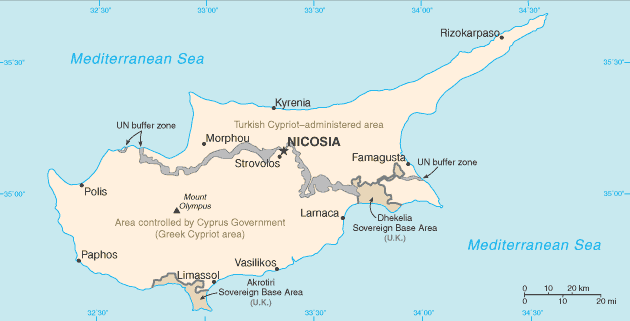
As some of you may recall, the ruling junta in Greece staged a coup in 1974 to overthrow the government of Cyprus. Five days later, Turkey responded by sending in troops in what it called a peace operation and what the Greek Cypriots described as an invasion.
After some brief fighting, Turkey took control of the northern part of the island, and in 1983 it declared the territory the Turkish Republic of Northern Cyprus (TRNC). Since then there has been an uneasy standoff, with UN troops keeping the two sides apart. The Greek Cypriots still claim the whole island and describe the hated Turkish military as an army of occupation.
De Facto Independence
The Turks, on the other hand, demand some form of recognition of their de facto independence, which the rest of the world refuses to accept. The international court of human rights last year ruled that Turkey’s 28-year occupation of northern Cyprus was an illegal act.
But here is the good news: For more than three decades, Greek Cypriots and Turkish Cypriots haven’t been killing each other, as they used to do for so many years before 1974. In fact, some 5,000 people were killed and 200,000 were displaced during the civil war that preceded the partition. Moreover, the Greek part of Cyprus has been doing quite well and even joined the EU in 2004. At the same time, the EU lifted an economic embargo on the Turkish side and endorsed a plan to reunify the island that had been rejected by the Greek Cypriots.
In short, divided Cyprus, including the virtual Turkish state, seems to be doing better than many unitary states around the world.
That the status quo in Cyprus will probably be maintained for several years to come has to do with regional and global power politics. Turkey is a midsize global power, a member of NATO, an important Muslim state, and a close military ally of Washington. Greece is a member of the European Union and has a “special relationship” with both the United States and Russia.
So here is the catch: Unless all the major players that are involved in Cyprus, in particular Turkey, agree on a final-status solution to the political future of the island, there won’t be an agreement, and the virtual Turkish state, also known as TRNC, will still be with us.
Which explains why the virtual state of Kosovo will probably also survive for many years to come, and why in addition to the hurricanes in Florida, the wildfires in California, and the “re-launching” of peace talks over Cyprus, you can now add the “fresh” peace talks over Kosovo to the list of annual events that may follow you to the grave.
Kosovo is officially a province of Serbia but is the subject of an ongoing territorial dispute between the Serbian government and the province’s majority ethnic Albanian population. Since the Kosovo war, the province has been administered by the United Nations as a protectorate.
Questions have been raised about whether an independent Kosovo would be politically or economically viable. But the most important obstacle to any final-status solution to the province’s political future is the inability to reconcile the incompatible positions of the Serbian and Albanian sides.
Serbia‘s position is backed by its powerful traditional ally, Russia. And while Washington and most EU members sympathize with the Albanian Kosovars, they are concerned that an independent Albanian-ruled Kosovo would produce a momentum for the formation of a Greater Albania in the Balkans. Hence, expect the status quo in Kosovo in the form of its virtual state to be maintained in the next few years. On one level, that’s depressing. On another level – so long as Albanians and Serbs are not killing each other – it’s not really bad news.
In a way, the world’s leading virtual state, Taiwan (the Republic of China), also happens to be one of the world’s most prosperous and technologically advanced economies, in addition to being a democracy. It’s true that its existence depends on a very delicate balance of power involving the U.S. and China (PRC), which regards Taiwan as being under its sovereignty. But this make-believe diplomatic design seems to be working quite well, and notwithstanding the rhetoric on all sides, few really expect the U.S. and China to go to war over Taiwan in the near future.
So we’ve seen the future of the virtual state, and it seems to be working like this: When global powers, nation-states, and competing national, ethnic, and religious groups fail to reach an agreement on the status of this or that coveted territory, they substitute the nonfiction genre of power politics with a fictional one.
Say you have a state called Iraq, which is a member of the UN in which a low-intensity civil war is taking place (involving Arab Sunnis, Arab Shi’ites, and Kurds), which is under the military occupation of a global power (the U.S.), and whose status affects important regional players (including Turkey, Iran, Syria, Jordan, Saudi Arabia) with links to the major Iraqi players.
Everyone is expressing public support for maintaining the unity of Iraq, while on the ground the reality is reflecting a gradual process of division, if not partition, into three mini-states, including Kurdistan, where students don’t even learn Arabic in schools anymore. But a fully independent Kurdistan won’t be accepted by Turkey and Iran, and an independent Shi’ite state with ties to Iran would be regarded as a threat to the neighboring Arab Sunni states and to the U.S.
Make-Believe Diplomacy
Instead of searching for a final-state political solution to Iraq, why not accept the reality on the ground by adopting a make-believe form of diplomacy? Yes, Iraq will remain unified as a federal state until further notice. In the meantime, we’ll have three virtual states.
The Kurdish one already exists for all practical purposes, and a U.S.-Turkish condominium in the province would help diffuse some of the explosive problems there (refugees, Kirkuk, oil, status of Turkmens). A détente between the United States and Iran would be necessary to help bring some stability to the Arab Shi’ite virtual state. And the neighboring Arab Sunni states could provide military support to maintain order in the Arab Sunni province.
And next year, and the year after, we’ll probably have “peace talks” on Iraq (and Cyprus, and Kosovo) aimed at determining its final political status as part of an agreement among all those involved. My guess is that such an accord will not be reached next year or the year after. But if virtual states can help stop bloodshed and prevent wars, why should we make an effort to keep the real ones alive?
Copyright © 2005 Singapore Press Holdings Ltd. All rights reserved.