



Chris Hedges is a Pulitzer Prize-winning veteran foreign correspondent, having covered foreign conflicts in Argentina, El Salvador, Nicaragua, Columbia, Guatemala, Bosnia, Iraq, Sudan, Algeria, India, Israel/Palestine, Turkey, and Kosovo for the New York Times, Dallas Morning News, Christian Science Monitor, and National Public Radio. Based on this experience, he authored the books War is a Force that Gives Us Meaning and What Every Person Should Know About War. He was a guest on my radio show July 23 [stream] [download mp3].
| ||||||||||

War is ultimately about collectivism. During crisis, individuality fades in favor of team effort. During violent conflict, particularly between governments, the world becomes, especially it seems for Americans, a giant, bloody football game: our team versus theirs, us versus them, good versus evil. Go, team, go.
This, of course, leads to all sorts of fallacious thinking, such as “death to them is not like death to us,” “we have to let them bomb us so they won’t know we’ve broken the codes,” “using nuclear bombs on civilians saved lives,” “everything changed on September 11th,” and “Don’t you understand that we are at war?” The last two are usually intended as a blanket permission slip for the state to break any law, tell any lie, and kill any person – so long as it’s to protect “us” from “them.”
In George Orwell’s nightmarish dystopia 1984, the world is divided into three empires in a state of perpetual warfare, because “the consciousness of being at war, and therefore in danger, makes the handing-over of all power to a small caste seem the natural, unavoidable condition of survival.” Every so often, a bomb falls in a lower-class neighborhood and kills enough people to remind them that they are at war and need Big Brother to protect them.
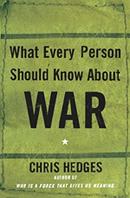 Hedges describes patriotism in his book as merely a “thinly veiled form of collective self-worship.” As Randolph Bourne said in 1918, “War is the Health of the State”:
“The moment war is declared … the mass of the people, through some spiritual alchemy, become convinced that they have willed and executed the deed themselves. They then, with the exception of a few malcontents, proceed to allow themselves to be regimented, coerced, deranged in all the environments of their lives, and turned into a solid manufactory of destruction toward whatever other people may have, in the appointed scheme of things, come within the range of the Government’s disapprobation. The citizen throws off his contempt and indifference to Government, identifies himself with its purposes, revives all his military memories and symbols, and the State once more walks, an august presence, through the imaginations of men. Patriotism becomes the dominant feeling, and produces immediately that intense and hopeless confusion between the relations which the individual bears and should bear toward the society of which he is a part. The patriot loses all sense of the distinction between State, nation, and government.”
The “few malcontents” during America’s wars have always provoked the wrath of the state. From John Adams’ Alien and Sedition Acts to Lincoln’s filling of military prisons with journalists and other dissenters to the terrible Wilsonian purges of Bourne’s day, through the Cold War presidents’ COINTELPRO and recent intimidation of antiwar protesters, the “good of the whole” has always outweighed the rights of the individual from the state’s point of view.
Hedges says that war is a narcotic, in fact a more powerful addiction than any drug. Our government is hooked on it, and it’s destroying our country. For example, our so-called representatives in congress just made the supposedly temporary parts of the unconstitutional PATRIOT Act permanent.
Other negative components and long-lasting side effects of war collectivism are racism and the corruption of language. As in the mass slaughter of “Tutsis” by “Hutus” (these were ethnicities essentially invented by the Dutch, according to ethnologist Luc de Heusch) in Rwanda in 1994, all that is necessary to convince people that it’s perfectly okay to torture and murder is to repeat over and over again that “the enemy” (meaning, of course, many people) is in fact not human at all, but “cockroaches,” “nips,” “gooks,” “krauts,” “ay-rabs” or “hajis.”
 As the New York Times quotes an unidentified member of the U.S. Army’s 337th Company, which was in charge of interrogations of prisoners at Bagram Air Force base in Afghanistan where at least two men were murdered in custody:
“‘We were pretty much told that they were nobodies, that they were just enemy combatants,’ he said. ‘I think that giving them the distinction of soldier would have changed our attitudes toward them. A lot of it was based on racism, really. We called them “hajis,” and that, psychology, was really important.'”
It’s amazing what a little dehumanization can accomplish. Perfectly nice kids, turned into torturers by their government’s crafty use of language.
During the Bosnian war, Hedges says in War Is a Force That Gives Us Meaning:
“Many Muslims called the Serbs ‘Chetnicks,’ the Serbian irregulars in World War II, who slaughtered many Muslims. Muslims, for many Serbs in Bosnia, were painted as Islamic fundamentalists. The Croats, to the Serbs and Muslims, were branded ‘Ustache,’ the fascist quislings who ruled Croatia during World War II. And there were times when, in interviews, it was hard to know if people were talking about what happened a few months ago or a few decades ago. It all merged into one huge mythic campaign.”
A mythic campaign that cost 250,000 real lives.
Hedges says that if you add it all up, there have only been 99 years of recorded human history where there was not a war going on somewhere, so our odds aren’t that great, it’s true, but the supposed usefulness of war has been shown to be false time and again. Invasion is no way to obtain resources; it costs much less to simply pay for what is needed. The death and destruction only ensure new enemies for the future.
If mankind is to have a future, it will be a future of individualism. If the politicians of the world continue to act as though “their” countries can only be successful at the expense of others, we are doomed. There are just too many nuclear bombs on this planet to be able to maintain perpetual war without eventual catastrophe.
War is not glorious, it is not heroic – war is death. If our society is out to spread the Anglo-American tradition of individual liberty, property rights, and open markets, let’s start by acting out our own creed as an example to the rest, and start treating the people of earth, and each other, like what we are: people.
