



 Foreign Follies: America’s New Global Empire
Doug Bandow
Xulon Press, 2006
384 pp.
To say that Doug Bandow is prolific would be an understatement of enormous proportions. He turns out a weekly column for Antiwar.com and contributes to two blogs – 4Pundits and Citizen Outreach. Bandow is also the author of several books – Korean Conundrum: America’s Troubled Relations With North and South Korea (with Ted Galen Carpenter), Tripwire: Korea and U.S. Foreign Policy in a Changed World, The Politics of Envy: Statism as Theology, Perpetuating Poverty: The World Bank, the IMF, and the Developing World (co-edited with Ian Vasquez), The U.S.-South Korean Alliance: Time for a Change (with Ted Galen Carpenter), and Beyond Good Intentions: A Biblical View of Politics (with Marvin Olasky). For those of us who strive (and often struggle) to write, it’s tempting to envy Bandow’s seeming ease discussing – with style and wit – an array of issues (if he were ruggedly handsome too, we’d have to hate him). His voice is one of the few of reason and sanity that rises above the shrill din of partisan politics and pundits.
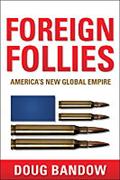 Because of the Iraq fiasco, it is fashionable to blame the Bush administration for being the Ziegfeld of America’s foreign policy folly. True enough, Iraq may be the height of U.S. recklessness – an unnecessary war against a phantom threat that has given jihadists a convenient target in their own neighborhood, has created greater anti-American sentiment throughout the Muslim world, and threatens to break the U.S. Army – but such recklessness did not begin with the Bush administration. In Foreign Follies: America’s New Global Empire (Xulon Press, 2006), Doug Bandow has collected essays spanning more than a decade to demonstrate that U.S. foreign policy run amok predates the current White House, though the Bush administration has made things worse. (There is, of course, the now obligatory chapter on Bush’s disastrous Iraq policy – the mother of all unnecessary military interventions.) According to Bandow, the problem is a direct result of the end of the Cold War:
"With America’s emergence as a hyperpower enjoying a unipolar moment, as the globe’s only superpower – and on and on, as some would-be imperialists regularly remind the rest of us – more than a few policymakers in Washington want to take advantage of the country’s opportunity to reorder the globe by force, if necessary."
The idea that the United States could reshape the world was based on the notion that with the Soviet Union in the dustbin of history, Washington could do as it pleased with no opposition and without cost. But as the saying goes, there is no such thing as a free lunch. While Democrats can rightly make the case for the costs and consequences of unnecessary intervention with regard to Iraq, they won’t like that Bandow also makes the case with respect to humanitarian intervention (itself an oxymoron when conducted by force of arms by the U.S. military), which was the hallmark of the Clinton administration:
"The response by some advocates of humanitarian intervention is: well, what about Hitler? If he was merely killing his own people, and not conquering other countries, shouldn’t we still have intervened? That question cannot be answered without considering various countries’ relative interests at stake, capabilities of intervening, and costs of acting. The very same question could be asked of Stalin and Mao, both of whom slaughtered more people than did Hitler. Should the U.S. have intervened to halt the starvation of the Ukraine or great purges in the U.S.S.R.? Should Washington have deployed military forces to stop China’s disastrous Great Leap Forward? Humanitarianism without regard for consequences and costs is good intentions run amok."
Bandow isn’t bashful about pointing out the problems with a humanitarian interventionist policy, such as the criteria for intervention:
"We must be prepared either to say that Somali lives are more valuable than those of Armenians, Bosnians, and Liberians, or to garrison the globe for humanitarian reasons."
He doesn’t pull any punches pointing out the hypocrisy of such a policy:
"When white Europeans are dying, the Clinton administration acts. When black Africans are dying, Washington talks. Such is the hypocritical cynicism that passes for foreign policy today. …
"The administration’s reluctance to act does seem extraordinary, given the president’s promise, offered barely a year ago when he visited the Balkans, to stop ethnic cleansing anywhere in the world. But residents of East Timor soon learned what frightened civilians in Sierra Leone are realizing today: he was only kidding."
Finally, interventionists of all stripes won’t like the conclusion Bandow comes to:
"America should not be the 911 number for the rest of the world."
During the Cold War a case could be made for the United States needing to act as a counterbalance to Soviet expansionism and respond to crises that erupted around the world. But "the end of the superpower competition means the world is no longer a zero-sum game, with a foreign ‘loss’ benefiting America’s adversaries." Yet the United States continues to subsidize the security of our rich allies in Europe who are no longer menaced by the threat of Soviet tanks rolling through the Fulda Gap. And because NATO keeps expanding rather than being disbanded, the United States is obligated to defend the likes of "Poland, Hungary, Romania, the Baltic States, Ukraine, and whoever else ends up on a NATO wish list." Similarly, the United States need not put its security at risk for South Korea and Japan, both of whom can afford the military expenditures necessary to defend themselves against North Korea. In fact, it makes even less sense against a nuclear-armed North Korea – putting Los Angeles at risk of nuclear incineration (though Pyongyang has pledged to shut down its nuclear program as a first step toward disarmament) to keep the North Koreans from crossing the 38th Parallel.
And if our friends in Europe and Asia are rich enough to pay for their own defense, then certainly too are the oil-rich nations of the Middle East. The United States does not need to defend countries such as Saudi Arabia to assure access to oil. As Bandow points out, "Saudi Arabia needs America more than America needs Saudi Arabia." President Bush and Crown Prince Abdullah may have held hands at the president’s ranch in Texas, but the Saudis are fickle friends at best. For example, Bandow writes that in 1996, "the Saudis refused, despite U.S. urging, to take custody of bin Laden from Sudan." We can only imagine how different things would be had they done so. Moreover, as Bandow observes:
"There were many causes to September 11, but a contributing factor was America’s willingness to make common cause with the morally decrepit, theocratic monarchy in Riyadh. Observed Deputy Defense Secretary Paul Wolfowitz, the price of the commitment has been ‘far more than money.’ America’s presence ‘in the holy land of Saudi Arabia’ along with the bombing of Iraq were ‘part of the containment policy that has been Osama bin Laden’s principal recruiting device, even more than the other grievances he cites.’"
Ultimately, the reason Bandow’s book is so important is because he understands the inextricable link between unnecessary U.S. interventionism and the threat of terrorism. Indeed, in "The Price of Giving Offense," written in August 1998, Bandow is almost prescient:
"Washington still needs to decide whether U.S. interests are important enough to warrant intervention. And that requires remembering that intervention begets terrorism.
"The cost of terrorism is high enough today. As weapons of mass destruction spread, however, the price could become staggering.
"Imagine the use of biological, chemical, or nuclear weapons at the World Trade Center, in the heart of New York City’s financial district. As potential terrorists’ power grows, interventional gains will become increasingly foolish."
Sadly, U.S. policymakers "delude themselves that Washington is suffering only because it is busy promoting, as the President [Clinton] claimed, ‘peace and democracy’ around the globe."
Even sadder is that President Bush makes the same ill-conceived argument. Note to President Bush: If you are still having a reading contest with Karl Rove, put Doug Bandow’s Foreign Follies at the top of your reading list.
