



 The Army of World War II, you might say, was the last Army of the republic. It performed great deeds, but there was not much luxury, not even for the generals and admirals. Nobody was paid much. Travel was by military plane, troop train or warship, even for generals, admirals and world leaders.
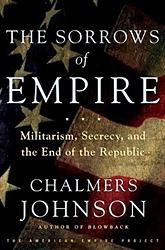
 Not so in today’s imperial Army. According to Chalmers Johnson, an excellent writer, in his new book, The Sorrows of Empire: Militarism, Secrecy, and the End of the Republic, the Defense Department maintains a fleet of 71 Lear jets, 13 Gulfstream IIIs and 17 Cessna Citation luxury jets. That’s in case any of the brass wish to visit the military’s ski resort in the Bavarian Alps or any of the 234 military golf courses around the world. The secretary of defense, of course, has his own private Boeing 757.
Or maybe the brass might wish to visit some of the 702 overseas bases the United States has in 130 countries, or perhaps the 6,000 it has in the United States. The commander in chief, of course, has Air Force One and an entourage traveling with him that would rival any of the triumphal marches of Roman emperors.
Johnson says the Pentagon reports that some 253,288 uniformed personnel are deployed overseas, plus a roughly equal number of dependents and Defense Department civilian employees. He also says the Pentagon figures don’t include bases in Kosovo, Iraq, Afghanistan, Kuwait, Kyrgyzstan, Qatar and Uzbekistan. Except for the one in Kosovo, those were all set up following the Sept. 11 attacks.
Excuse me, but I’m old-fashioned. I was a $70-a-month private who ate Army cooking and took his turn at KP (kitchen police), all of which is now done by civilian contractors, or so I’m told. Besides, I thought the Cold War was over. I thought the idea, after the Soviet Union collapsed, was to close overseas bases and bring the troops home. I seem to recall that the president, in his first campaign, promised a modest foreign policy and even hinted at reducing overseas deployments.
Instead, he’s announced an aggressive foreign policy of pre-emptive attacks, has made war on two countries and has increased overseas deployment. In the process, of course, he has strained the Army and had to call up reserves and National Guardsmen in numbers not seen since World War II.
Since there is virtually no coverage of the Defense Department other than the SecDef’s smart-alecky news conferences, I highly recommend Johnson’s new book as well as his old one, “Blowback: The Costs and Consequences of an American Empire.” If you look at the original publication date of his first book, you will find that it is quite prophetic.
From whence comes the American itch to control the world? That’s an interesting question. One wonders why, when Washington, D.C., is the AIDS capital of America, the president is so keen on spending American tax dollars to fight AIDS in Africa. Alas, perhaps the answer is as simple as the fact that the district has neither oil nor uranium, not to mention its habit of voting heavily Democratic.
The old Marxist answer was that as capitalists finished exploiting the domestic market, they would inevitably seek to expand overseas. I don’t think the old grump foresaw the rise of global corporations, which now seek to turn the entire Earth into one domestic market – for themselves, of course.
The truth is quite simple: An empire increases the danger for the American people, as empires always make more enemies than friends, not to mention inciting envy and hatred. Maintaining an empire will eventually break us, as it has every single empire of the past.
To paraphrase a Mexican bandit in a classic movie, “I don’t want no stinking empire.” I want my republic back. It was cheaper to run, much freer and was viewed affectionately by the world because it minded its own business. If it means a return to KP and putting generals and admirals in the jump seats of cargo planes and in a bunk in a warship, so be it. That’s little-enough hardship for generals who like to direct their wars as far from the sound of guns as possible.
Copyright 2004 King Features Syndicate